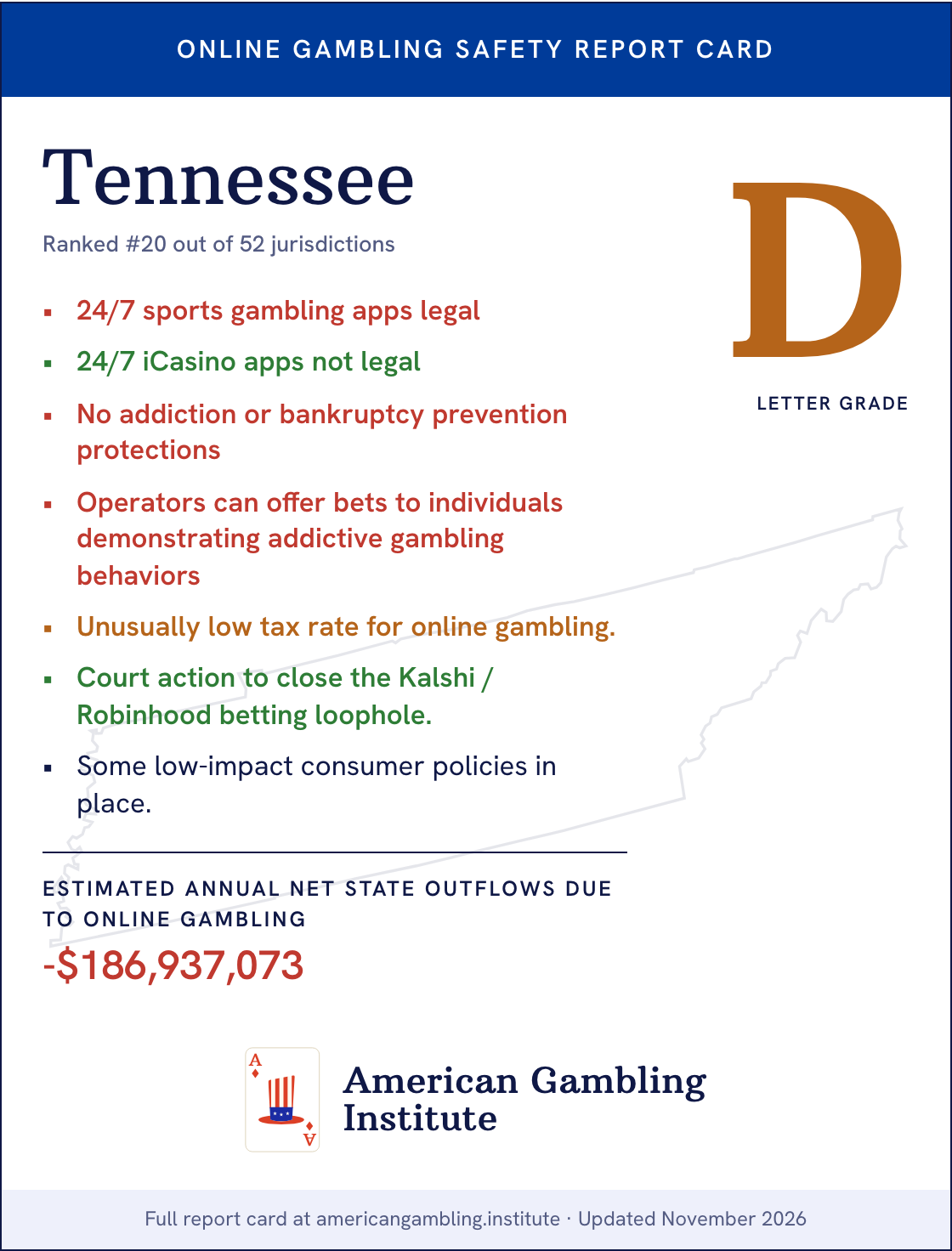
Tennessee
Ranked #20 out of 52 jurisdictions
- 24/7 sports gambling apps legal
- 24/7 iCasino apps not legal
- No addiction or bankruptcy prevention protections
- Operators can offer bets to individuals demonstrating addictive gambling behaviors
- Unusually low tax rate for online gambling.
- Court action to close the Kalshi / Robinhood betting loophole.
- Some low-impact consumer policies in place.
Institute
Tennessee
TNScore: 63 / 100
A+=100+ · A=90–99 · B=80–89 · C=70–79 · D=50–69 · F=30–49 · F−=0–29
40 + 0 + 0 + 19 + 2 + 2 − 0
- 24/7 sports gambling apps legal
- 24/7 iCasino apps not legal
- No addiction or bankruptcy prevention protections
- Operators can offer bets to individuals demonstrating addictive gambling behaviors
- Unusually low tax rate for online gambling.
- Court action to close the Kalshi / Robinhood betting loophole.
- Some low-impact consumer policies in place.
| Legal status | Notes & sources | |
|---|---|---|
| Online sports betting | Legal |
|
| iCasino (online casino-style games) | Not legal |
|
| Minimum age (sports betting) | 21+ |
|
Online gambling apps route losses to out-of-state operators and vendors, creating large net leakages from state economies and reduced in-state spending by residents, even after deducting retained state taxes and activity from in-state app operations.
Model: gambling-flows (mid scenario, 2025; source data 2026-10-12).
- When betting apps were legalized/launched (sports betting): online launch: November 1, 2020.
- Main legal model / provisions (sports betting): Tennessee passed the Tennessee Sports Gaming Act on June 4, 2019. The state’s unique online-only sports betting market launched in November 2020.
- Online casino / iCasino: Not legal.
- Score-relevant protections observed here: Credit card funding ban (+5), Problem gambling hotline (+2), Funding for problem gambling messaging (+2), Non-integrated Self-exclusion list (+2), Close the Kalshi “investment contract” loophole (+8)
- May 27, 2021 — Proposed/attempted: Tennessee Governor Bill Lee signs SB 588 , which transfers sports betting regulatory powers from the Tennessee Education Lottery to the newly formed Sports Wagering Advisory Council.
- States With Legal Sports Betting - US Legal Sports Betting Timeline (Sports Betting Dime, 2018-05-18). Accessed 2026-11-07.
- US Online Casino Sites & Legal Updates January 2026 (Sports Betting Dime, 2025-02-11). Accessed 2026-11-07.
- TN Sports Betting Apps: Best Sportsbooks & Promos in Tennessee (Sports Betting Dime, 2020-07-07). Accessed 2026-11-07.
score = policyPoints + protectionsPoints + taxPoints + agePoints − promotionPenalty
(40 + 0 + 0) + 19 + 2 + 2 − 0 = 63
Safety Scoring
Scoring methodology and formula.
Online sports betting apps are legal.
- State Gaming Map (American Gaming Association). Accessed 2026-11-07.
iCasino apps are not legal.
- State Gaming Map (American Gaming Association). Accessed 2026-11-07.
Bonus not awarded — at least one form of online gambling is legal in this state.
- State Gaming Map (American Gaming Association). Accessed 2026-11-07.
Statutory tax rate (sports betting operators): 1.85% of handle
- Since July 1, 2023, Tennessee levies a 1.85% privilege tax on total wagers accepted (handle) rather than a tax on gross gaming revenue — the only state to tax handle instead of revenue.
- Taxed on handle (total wagers), not gross gaming revenue.
- Tennessee General Assembly Legislation (wapp.capitol.tn.gov). Accessed 2026-11-07.
- TN Sports Betting Apps: Best Sportsbooks & Promos in Tennessee (Sports Betting Dime, 2020-07-07). Accessed 2026-11-07.
- Steve Ruddock. Sports Betting Tax Rates & Licensing Fees By State 2026 (BettingUSA.com, 2022-03-17). Accessed 2026-11-07.
0 points for 18+, 2 points for 21+, 5 points for 25+.
- State Gaming Map (American Gaming Association). Accessed 2026-11-07.
Bans using credit cards to fund online betting.
- https://www.law.cornell.edu/regulations/tennessee/Tenn-Comp-R-Regs-1350-01-.08 (law.cornell.edu). Accessed 2026-11-07.
Publicly advertised problem-gambling hotline/helpline (and referral to support resources). This is a low-efficacy intervention.
- National Council on Problem Gambling. About the National Problem Gambling Helpline™ (National Council on Problem Gambling (NCPG), 2023-11-22). Accessed 2026-11-07.
- Tennessee Problem Gambling Resources | National Council on Problem Gambling (National Council on Problem Gambling, 2023-11-20). Accessed 2026-11-07.
- Tennessee - NAADGS (NAADGS, 2020-01-22). Accessed 2026-11-07.
- Problem Gambling Programs (tn.gov). Accessed 2026-11-07.
- TDMHSAS Helpline & Redline (tn.gov). Accessed 2026-11-07.
- SWAC - Gambling Addiction Services (tn.gov). Accessed 2026-11-07.
Earmarks funds for problem gambling education/public-awareness messaging (not just voluntary operator messaging). This is typically small and often poorly executed.
- NAADGS. [Archived] 2023 Budget Update: Publicly Funded Problem Gambling Services in the United States (National Association of Administrators for Disordered Gambling Services (NAADGS), 2024-06-04). Accessed 2026-11-07.
- NAADGS. 2023 Budget Update: Publicly Funded Problem Gambling Services in the United States (PDF) (National Association of Administrators for Disordered Gambling Services (NAADGS), 2024-06-05). Accessed 2026-11-07.
- Tennessee Problem Gambling Resources | National Council on Problem Gambling (National Council on Problem Gambling, 2023-11-20). Accessed 2026-11-07.
- Tennessee - NAADGS (NAADGS, 2020-01-22). Accessed 2026-11-07.
- Problem Gambling Programs (tn.gov). Accessed 2026-11-07.
State provides a self-exclusion program (ideally centralized across licensed operators). This is a low-efficacy tool when not integrated into the gambling user flow.
- SWAC - Fantasy Sports Self-Exclusion (tn.gov). Accessed 2026-11-07.
- TN Voluntary Sports Wagering Self-Exclusion Application (tn.gov, 2023-12-14). Accessed 2026-11-07.
Mandatory, enforceable, cross-operator loss limits that cap how much a person can lose in a time period (e.g., monthly). Highly effective for preventing bankruptcies.
Bans or tightly limits promotional inducements (bonuses, risk-free bets, boosted odds) used to accelerate losses.
Prohibits in-game/live betting so wagers can only be placed before events begin.
Requires operators to stop offering bets when users exhibit defined high-risk patterns (not merely provide links to a hotline).
Requires explicit spousal consent before connecting or using a shared/joint bank account for gambling.
Requires players to set limits at signup (or imposes defaults) rather than burying optional limit-setting tools.
Imposes a mandatory waiting period between deposits and wagering to reduce compulsive 'tilt' behavior.
Imposes meaningful limits on gambling advertising (e.g., time/place bans, tobacco-style warnings) beyond generic 'gamble responsibly' language.
Removes gambling apps from app stores, where the easy access and notification systems increase addictive patterns. In states with legal online gambling, these services would remain available on websites.
Requires public reporting on operator harm indicators (e.g., share of revenue from high-risk users, intervention rates), enabling oversight.
State action to block sports event contracts marketed as federally regulated derivatives. Joining the multi-state attorney general coalition (38 AGs as of the April 2026 Massachusetts brief) earns 2 points; cease-and-desist earns 4; court action earns 8 (max 8).
- Tennessee orders Kalshi, Polymarket and Crypto.com to cease sports betting contracts (coindesk.com). Accessed 2026-11-07.
- Nate Raymond. US judge blocks Tennessee from barring Kalshi's sports events contracts (Reuters, 2026-01-13). Accessed 2026-11-07.
- Yost Co-leads Bipartisan Coalition Targeting Gambling Loophole - Ohio Attorney General Dave Yost (ohioattorneygeneral.gov). Accessed 2026-11-07.
- 2025-6-17-NJ-Amicus.pdf (ohioattorneygeneral.gov, 2025-06-17). Accessed 2026-11-07.
- Attorney General James Joins Bipartisan Coalition Defending States’ Gambling Laws Against Prediction Markets (New York State Attorney General, 2026-05-29). Accessed 2026-11-07.